Wind-Creased Shingles: Can They Be Repaired or Must the Slope Be Replaced?
Determining whether wind-creased shingles can be repaired or require slope replacement comes down to shingle brittleness and thermal seal failure: while a single isolated creased shingle on a young roof (<7 years) can theoretically be swapped out, roofs older than 8 to 10 years fail the Arkansas building code repairability test because unsealing adjacent brittle shingles causes catastrophic tearing, legally mandating full slope or total roof replacement.
After severe thunderstorm fronts or straight-line downbursts sweep across Pulaski County, homeowners often walk their property and assume everything is fine because no shingles are lying on the lawn. However, severe wind damage frequently leaves shingles physically on the roof deck, but permanently destroyed through horizontal wind creasing. Understanding the structural mechanics of wind creases prevents costly delayed leaks.
Wind-Crease Damage: Repair vs. Replacement Decision Matrix
Roofing forensic engineers and insurance claims specialists evaluate specific structural criteria to determine whether a wind-damaged roof can be surgically repaired or must be replaced:
| Evaluation Factor | Localized Spot Repair Permitted | Full Slope / Complete Replacement Required | Governing Code / Industry Standard |
|---|---|---|---|
| Roof Age & Flexibility | Under 7 years; shingles remain pliable and oil-rich | Over 8–10 years; asphalt has oxidized and hardened | ASTM D3462 Tear Resistance Standard |
| Crease Frequency per Slope | 1 to 3 isolated shingles across an entire plane | >5 creased shingles per 100 sq ft (1 square) | Haag Engineering Wind Damage Protocol |
| Thermal Seal Integrity | Surrounding shingle adhesive strips intact and clean | Widespread unsealed tabs contaminated by airborne dust/pollen | ASTM D7158 Uplift Resistance Rating |
| Shingle Brittleness (Bend Test) | Adjacent shingles bend 45° to allow nail removal without cracking | Adjacent shingles snap, crease, or lose granules during nail extraction | IRC Section R908.3 Replacement Rule |
| Material Availability | Current production line matching exact dimensions and exposure | Discontinued shingle size, metric vs English sizing mismatch | Arkansas Insurance Line-of-Sight Standard |
What Is a Wind Crease? The Physics of Tab Uplift
Asphalt shingles are engineered to form a unified wind-resistant monolithic membrane. Each shingle course overlaps the one below it, sealed together by a heat-activated strip of elastomeric asphalt. During severe wind events (gusts of 55 to 80 mph common in Little Rock storms), negative pressure (aerodynamic uplift) acts like an airplane wing over the leeward edge of your roof:
1. Sealant Strip Delamination
When wind uplift force exceeds the tensile strength of the factory thermal seal, the adhesive bond breaks with a sudden pop. The shingle tab begins flapping rapidly in the turbulent airflow.
2. The Hinge Crease Fracture
As the tab bends upward repeatedly, it folds along a horizontal axis directly beneath the upper fastener line. Because standard shingles utilize rigid fiberglass scrim saturated with asphalt, the continuous folding motion snaps the internal glass fibers. The shingle now has a permanent structural crease.
3. Granule Loss and Bitumen Erosion
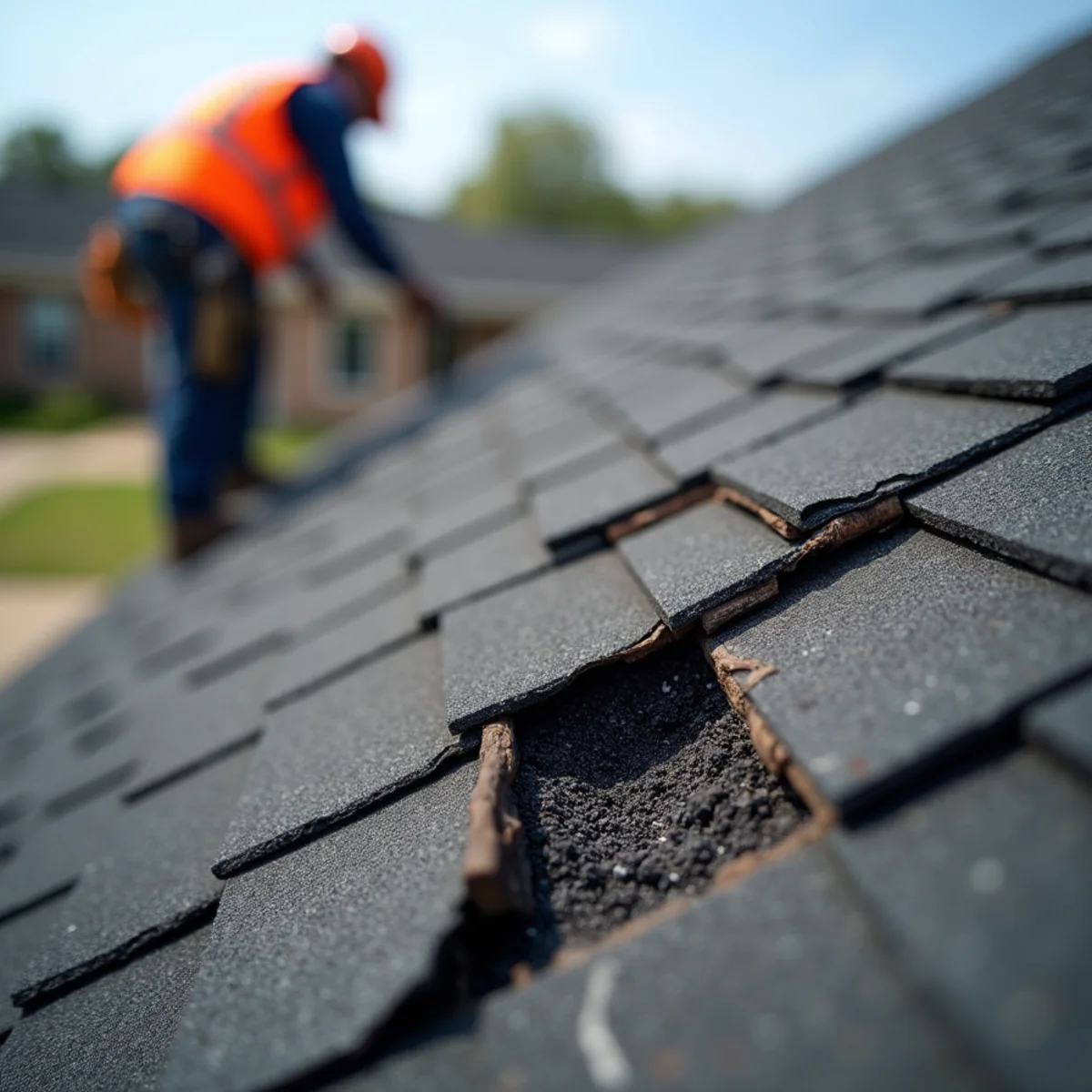
Along the horizontal crease line, surface mineral granules are crushed and ejected. When the wind subsides, gravity pulls the shingle back down. From the ground, the roof may appear completely intact, but the waterproof asphalt coating along the crease has been fractured through to the fiberglass substrate.
Why Caulking or "Gluing Down" Wind-Creased Shingles Is a Dangerous Mistake
Unqualified handymen often propose climbing onto the roof and squirting black roof cement or silicone caulk beneath lifted tabs. While this temporarily pins the tab down, it creates three catastrophic long-term problems:
- Internal Mat Rupture Remains Open: Caulking the underside does nothing to heal the snapped fiberglass fibers on the top face of the shingle. Water driven by sideways rains will channel directly through the horizontal crease fissure.
- Trapped Moisture and Rot: Excessive roof mastic blocks the engineered drainage channels between shingle tabs. Moisture that condenses beneath the shingles cannot weep away, leading to rot in the underlying plywood roof decking.
- Voided Manufacturer and Insurance Warranties: Shingle manufacturers (including GAF, CertainTeed, and Owens Corning) explicitly state that hand-sealing creased shingles does not restore the manufacturer’s wind warranty. If an insurer discovers mastic patches, they will classify future leaks as "improper maintenance" and deny subsequent claims.
The "Brittle Test": How IRC R908.3 Forces Full Slope Replacement
Under the International Residential Code (IRC) Section R908.3 enforced throughout Little Rock and Pulaski County, a roof repair cannot cause damage to surrounding sound building elements. To replace a single damaged shingle, a roofer must perform the following mechanical steps:
- Insert a flat pry bar beneath the damaged shingle and break the adhesive bond.
- Lift the overlapping shingle course above it to a 45-degree angle to expose the four to six galvanized roofing nails.
- Pry out the fasteners without gouging the underlayment.
- Slide in the new shingle, re-nail at the proper penetration angle, and hand-seal.
On an Arkansas roof that is 8, 10, or 15 years old, the shingle course being lifted to a 45-degree angle has lost its volatile plasticizers. When the roofer lifts it, the brittle shingle immediately develops a brand new wind-crease fracture across its own top line! Attempting to fix one shingle damages two more; attempting to fix those two damages four more. When this "spiderweb" damage occurs during an insurance repairability test, the roof is deemed structurally unrepairable, legally requiring the insurer to pay for the complete slope or full roof replacement.
Expert E-E-A-T Insight: Low-Angle Raking Light Documentation
Insurance adjusters frequently deny wind claims by asserting that shingles are "merely unsealed, not damaged." Unsealed shingles that have not yet creased can sometimes be re-adhered if the sealant strip is uncontaminated. However, once a shingle creases, it is functionally totaled.
To prove creasing to adjusters, our certified technicians employ low-angle raking light inspection protocols. By illuminating the roof plane with specialized high-lumen halogen work lights positioned parallel to the shingle surface at dawn, dusk, or under cloud cover, horizontal crease shadow lines become undeniable. We pair this with 20x macro digital photography showing broken fiberglass fibers within the crease trench. When supported by our forensic documentation, insurance carriers readily convert partial denial letters into full replacement approvals.
If your property was recently impacted by severe weather, contact our network for an immediate storm damage roof repair evaluation, professional insurance claim representation, and precision roof replacement in North Little Rock, Sherwood, and Central Arkansas.
Related Services & Central Arkansas Coverage
Frequently Asked Questions on This Topic
Clear, honest answers regarding storm damage, hail inspections, and insurance claims in Arkansas.
Inspectors conduct gentle lift tests and examine the shingle surface at an angle using low-angle raking light. Wind creases appear as dark horizontal lines where mineral granules have cracked and detached along the hinge fold directly beneath the upper fastener course.
Need Expert Advice on Your Roof?
Speak with a licensed Central Arkansas roofing professional right now at (773) 207-0769.
Have a Storm Question? Request an Inspection
Submit your details below and an on-call Little Rock roofer will follow up promptly.